California Naturalist Outing
Sepulveda Basin Wildlife reserve
11 a.m.-1 p.m.
Route: Entering space from the dirt parking lot below the archery fields.
Weather: Warm and slightly humid. 75 °F at start 80 °F at end.
An impromptu trip around the Wildlife Reserve to look at recent plantings (habitat restoration with CNPS LA/SMM and L.A. Sanitation and to get a feel for the state of the invasive mustards and grasses in May.
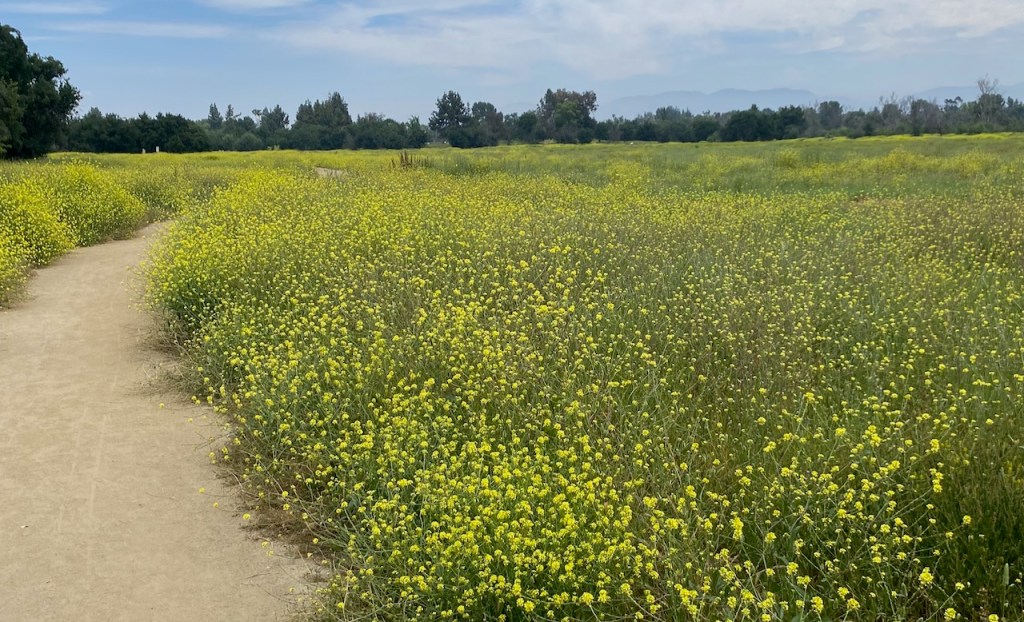
Most everything was still green and lush. This is on the heels of lots of recent rain from a very wet winter. Add the cooler overcast mornings and threat of monsoonal like rains and the planting/growing season is reaching into late May and early June. In particular, the last several days in the San Fernando Valley have been gloomy and overcast to start, burning off to warm, almost hot, afternoons. Summer is just over the horizon.
Like much of the flowers and blooms, the Sepulveda Basin has been slow to show flowers and is enjoying a late into the season bouquet. The clarkia are still a taunt pink, purple and fuchsia—just starting to set seed. The poppies, as sparse as they may be, are vivid and eye grabbing, mixed into the tall invasive grasses and mustard. And lupine showing their purple spears poking through the brush. Normally I would consider this landscape as mostly sage chaparral, but with the invasion of non-native plants, it’s become more a grassland meadow. I’m worried this will be problematic as we get into fire season.
Read: June Wildflowers in Bloom: A Colorful California Delight
The mustard gets its own mention as they have become nearly 6 feet in height in some places. Each plant is a happy oasis of green and yellow choking out anything that tries to get in its way. To say its thick would be an understatement. But you can see how the areas that the California Native Plant Society and Friends of the LA River have worked to remove it have allowed the native plants to get a foothold.
An interesting consequence of this mustard removal is where other invasives have moved in and established residence. In particular, annual sweet clover (Melilotus albus) and Maltese or Napa star thistle tocalote (Centaurea melitensis). Both have carpeted areas and are growing unchecked. Good that it’s not mustard, but no-less problematic as mono-crops occupying the space growing and ready to set seed.
Also of note, different types of mustard are flourishing. In the east field, Hirschfeldia incana (or short pod mustard) is springing up in areas untouched in years since the fire in 2019. In the west, Rapistrum rugosum (better known as bastard cabbage or turnip weed) is flourishing. Unsurprisingly, the mustard spread seems to be following the paths of humans and their companions. Mustard lines the trail edges and carried by foot and fur as people, dogs, bicycles and joggers enjoy the space. In some locations, the mustard encroaches both sides of the path creating a canopy of mustard “trees.”
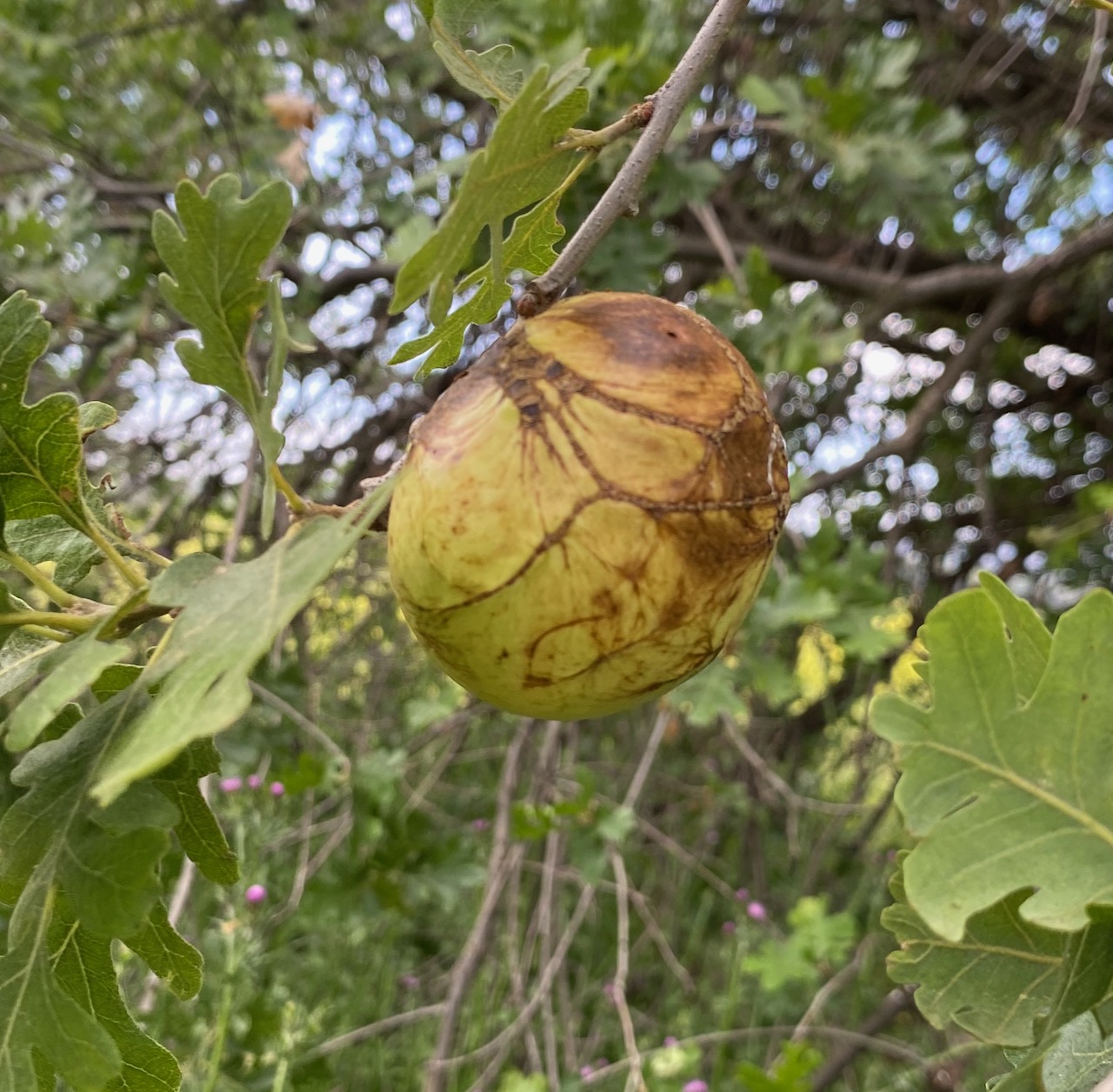
Along the path in the west field on the north side, I did happen upon a racquet ball sized wasp gall in a Valley Oak (Quercus lobata). It had a great deal of heft and density to it as I tested its weight in the tree. It looked to be fresh if that’s possible.



The one last observation of note was the density of the California wile rose (Rosa californica). On the lake side, the rose is absolutely flourishing. So much so that it forms thickets that would prohibit the most armored of gardeners wading into it. Almost nothing can grow out of it. I say that as a toyon (Heteromeles arbutifolia) our group planted in 2022 is sending stems vertically rather than horizontally trying to catch and hold the sunshine. It’s good to see it fighting for the space but I worry the struggle may be more than it can bear.
I should note, the Hollyleaf Cherry (Prunus ilicifolia) blooms are on their way to setting fruit. Still present but looking tired. And the Golden Currant (Ribes aureum) are outstanding. Most of the berries are a deep red-gold with a few ripe for the picking (and tasting). Sweet with a hint of tart. It’s a fantastic treat out in the field. I make it a point to stop and try them whenever I happen upon them.
With that, my observation trip was complete, and I made my way back to the parking lot and concluded my observation trip.
Field Observations
- Lots of invasive mustard and grasses.
- A few people walking and enjoying the space.
- Some walkers had dogs; most were off leash.
- Restoration plants were doing well.
- A few critters (cabbage moth and sphinx moth caterpillar).
- A wasp gall in a valley oak.
- An unopened Trojan condom on the path.
Observed species
- Valley Oak – Quercus lobata
- Mustard – Rapistrum rugosum
- Mustard – Hirschfeldia incana
- Maltease Star Thistle – Centaurea melitensis
- Annual yellow sweetclover – melilotus indicus
- Elegant Clarkia – Clarkia unguiculata
- california poppy – eschscholzia californica
- California Wild rose – Rosa californica
- Toyon – Heteromeles arbutifolia
- Hollyleaf cherry – Prunus ilicifolia
- Golden Currant – Ribes aureum
 Exploring Urban Ecosystems and Patch Ecology
5 responses to “Observing the Sepulveda Basin Wildlife Reserve in May”
[…] of the first things I noticed was how profuse the invasive weeds were. Much like what I observed in the Sepulveda Basin the day before, Maltese Star Thistle (Centaurea melitensis) and annual yellow sweet clover […]
LikeLike
[…] Location in May, 2023 […]
LikeLike
[…] the hillside. In past years, the plant would tower well over 6 feet (much like it is in the Sepulveda Basin at the time of this observation). Now, it seemed as though years of removal had paid off as the […]
LikeLike
[…] Read: Observing the Sepulveda Basin Wildlife Reserve in May […]
LikeLike
[…] Read: Observing the Sepulveda Basin Wildlife Reserve in May […]
LikeLike