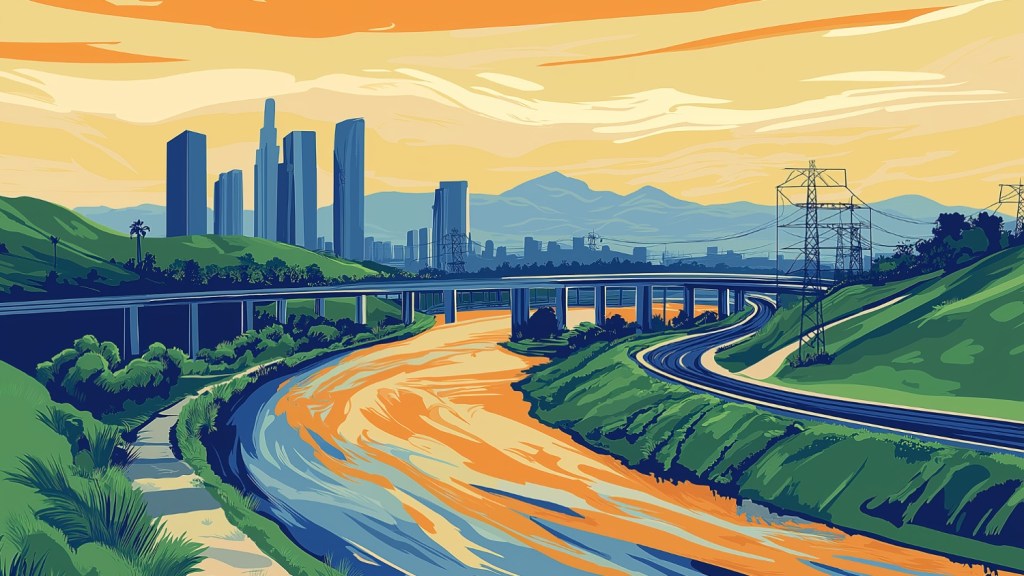
The Sepulveda Dam, located in the San Fernando Valley of Los Angeles, California, is a vital piece of infrastructure that reflects the city’s ongoing struggle to balance urban growth with natural forces. Built in the early 20th century, the dam was constructed to address the growing threat of flooding in the rapidly urbanizing Los Angeles Basin. Today, it stands as an enduring symbol of the city’s resilience, blending utility, history, and its role in reshaping the surrounding area.
This post delves into the history of the Sepulveda Dam, tracing its origins, design, construction, and its continued significance in the present day.
Los Angeles and Its Flooding Challenges
The story of the Sepulveda Dam begins with the history of the Los Angeles River and the periodic devastation caused by its flooding. For centuries, the river’s unpredictable path made it both a lifeline and a threat to the region. Early settlers, including the Tongva people, understood and adapted to the river’s natural tendencies. However, as the Los Angeles area transitioned from agricultural settlements to urban centers, managing the river became increasingly crucial.
The floods of 1914 and 1938 were particularly catastrophic, submerging vast swaths of the city and its surrounding areas. The 1938 flood alone resulted in over 100 fatalities, destroyed homes, and caused millions of dollars in damage (equivalent to billions in today’s terms). This disaster prompted urgent calls for a comprehensive flood control system to protect the burgeoning population and infrastructure.
The Flood Control Vision
In response to the devastating floods, the federal government authorized the Los Angeles County Drainage Area (LACDA) project, led by the U.S. Army Corps of Engineers. This ambitious initiative aimed to transform the Los Angeles River into a controlled waterway capable of handling heavy rainfall and reducing the risk of catastrophic floods.
Read: The Sepulveda Basin Wildlife Reserve: A Journey Through Time
Central to this plan was the construction of several dams, including the Sepulveda Dam, which would work in concert with a system of levees and concrete channels to manage the river’s flow. The location for the dam was chosen strategically: a flat, expansive area in the San Fernando Valley that could hold floodwaters and release them at a controlled rate downstream.
Design and Construction
The Sepulveda Dam was designed in the late 1930s, drawing on engineering innovations of the era. Its purpose was twofold: to act as a flood control structure and to create a retention basin for managing water during periods of heavy rainfall. Unlike many dams designed for water storage or hydroelectric power, the Sepulveda Dam’s primary function was to temporarily hold and gradually release water, mitigating flood risks in urban areas downstream.
Construction began in 1938 and was completed in 1941. Built of reinforced concrete, the dam spans approximately 6,500 feet in length and rises 57 feet above the valley floor. Its straightforward yet robust design prioritizes function over aesthetics, reflecting the urgent need for practical flood control solutions during that period.
The dam includes a massive spillway and gated outlets that allow engineers to control the release of water with precision. This system proved to be highly effective, providing a level of flood protection that reassured residents and facilitated further development in the surrounding areas.
Read: Observing the Sepulveda Basin Wildlife Reserve in July
World War II and the Sepulveda Basin
The completion of the Sepulveda Dam coincided with the United States’ entry into World War II. During this period, the dam and its surrounding area took on an additional role as a training ground for military operations. The Sepulveda Basin, the area behind the dam that serves as a floodwater storage zone, became a temporary site for military exercises and equipment testing.
After the war, the basin returned to its intended purpose as a flood control area. However, the infrastructure built during the war years laid the groundwork for future developments, including public recreation and environmental restoration projects.
Post-War Development and Urban Impact
The decades following World War II were marked by explosive growth in the San Fernando Valley. New neighborhoods, schools, and businesses sprang up around the Sepulveda Dam, taking advantage of the flood protection, it provided. The dam enabled large-scale development in areas that would have otherwise been uninhabitable due to flood risks.
However, this rapid urbanization also had unintended consequences. The Los Angeles River, once a natural and meandering waterway, became heavily channelized and disconnected from its ecosystems. Wildlife habitats were lost, and the natural beauty of the river was replaced by concrete infrastructure. The Sepulveda Dam and its associated flood control measures became emblematic of the trade-offs between safety and environmental stewardship.
The Sepulveda Basin: A Multifunctional Space
By the 1970s, interest in creating public spaces within the Sepulveda Basin began to grow. The U.S. Army Corps of Engineers and local governments recognized the potential for the basin to serve as more than just a flood control area. Projects were initiated to establish parks, sports fields, and the Sepulveda Basin Wildlife Reserve, which became a haven for native plants and animals.
The basin today is a diverse space that combines recreation, conservation, and flood control. Popular amenities include the Sepulveda Basin Recreation Area, Lake Balboa Park, and the Encino Golf Course. The area is a hub for outdoor enthusiasts, families, and nature lovers, offering a glimpse of what urban green spaces can achieve when thoughtfully integrated into city planning.
Challenges and Modern Relevance
As Los Angeles faces new challenges such as climate change and aging infrastructure, the Sepulveda Dam remains a crucial part of the region’s flood control system. However, its functionality and design are not without limitations. The dam was built to handle storms typical of the early 20th century, but the increasing intensity and unpredictability of modern weather events raise questions about its long-term efficacy.
Read: Southern California Planting Zones
To address these concerns, city planners and engineers are exploring ways to update the flood control system while incorporating ecological restoration and public engagement. Proposals such as the Los Angeles River revitalization plan aim to reimagine the river and its infrastructure, balancing flood control with the need for sustainable urban design.
Cultural Significance
The Sepulveda Dam has also become a cultural landmark, appearing in various films, television shows, and music videos over the years. Its stark concrete structure and open expanses have made it a favorite location for action sequences and dystopian landscapes, adding to its mystique as a piece of living Los Angeles history like this send sequence from the 1984 film Buckaroo Banzai.
Conclusion
The Sepulveda Dam is far more than a utilitarian structure—it is a cornerstone of Los Angeles’ growth and a reflection of the city’s evolving relationship with its environment. From its origins as a solution to catastrophic flooding to its role in enabling urban expansion, the dam’s history is interwoven with the story of Los Angeles itself.
Today, as the city grapples with new challenges, the Sepulveda Dam stands as a reminder of the ingenuity and determination that have defined its development. By preserving and adapting this vital piece of infrastructure, Los Angeles can continue to protect its residents while fostering a deeper connection between urban life and the natural world.
Sources
- “Los Angeles River and Sepulveda Dam,” U.S. Army Corps of Engineers Los Angeles District. Accessed November 2024. https://www.spl.usace.army.mil
- “Sepulveda Dam,” SoCal Landmarks. May 19, 2022. https://socallandmarks.com
- “The Great Los Angeles Flood of 1938,” Wikipedia. Accessed November 2024. https://en.wikipedia.org/wiki/Los_Angeles_flood_of_1938
- “Sepulveda Dam Basin Master Plan and Environmental Assessment,” Sepulveda Basin Wildlife Organization. Accessed November 2024. https://sepulvedabasinwildlife.org
- “History of Sepulveda Dam,” KCET Southern California. November 2024.
 Exploring Urban Ecosystems and Patch Ecology